
There was a period, not long ago, when shopping for erectile dysfunction treatment online was mostly a race to the bottom on price and delivery speed. That race has largely ended, not because anyone won it, but because the active ingredients involved are commodity generics, and competition eventually squeezed the margin out of undercutting. What has replaced it is a quieter, more useful question, and it is the one this piece sets out to answer: when a prescription arrives at your door, can you actually trace where it came from and who is accountable for it?
That question deserves a straight answer, not a marketing pitch. What follows is a working definition of verification as it applies to an ED prescription, a short test any reader can run on any provider’s website in a few minutes, an assessment of the major telehealth names measured against that test, and a plain-spoken FAQ. None of this is meant to tell anyone what belongs in their body. It is meant to make readers better at asking the right questions before they buy.
What changed, and why it matters
A few years back, “online ED clinic” meant something fairly narrow: a finished generic, sildenafil or tadalafil, dispensed by a U.S. pharmacy and mailed out. Verification barely came up as a topic, because the supply chain behind it was standardized and dull in the best sense. Since then the category has widened considerably, with dozens of brands, compounded and “personalized” formulations, chewables, troches, combination products, and a long tail of gray-market sellers offering the same molecules with no clinician and no nameable pharmacy anywhere in the picture. Two products can share an active ingredient and still have entirely different stories behind them. The only way to know which story applies to what you’re holding is to ask.
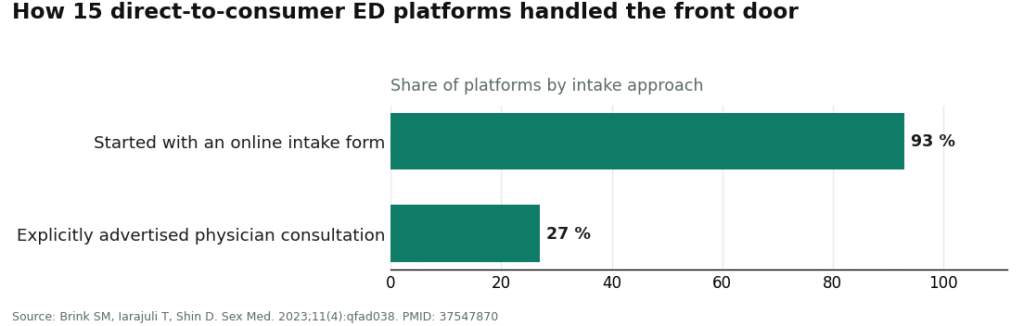
Most platforms would rather that question stayed unasked, and not necessarily out of bad faith. Verification introduces friction, and friction reduces conversions. The published research bears this out. A 2023 analysis in Sexual Medicine examined 15 direct-to-consumer ED platforms and found that 14 of them, 93 percent, opened the process with an online intake form, while only 4 of the 15 explicitly advertised that a physician would handle the consultation [2]. When the presence of a clinician is that easy to obscure, the sourcing behind the prescription is usually harder still to pin down. A 2025 study in Urology graded the health information these platforms present to patients and described reliability across the category as “universally poor,” with even the stronger performers leaving real gaps [3]. None of this means telehealth ED care is inherently unsound. It means the baseline is low enough that verification cannot be assumed. It has to be checked.
What “verified sourcing” actually means
The phrase gets used loosely, and it means something different depending on what’s being purchased.
For a finished, FDA-approved generic, verification is largely about chain of custody. Is the medication an FDA-approved finished drug, dispensed by a licensed U.S. pharmacy you can name, prescribed by a clinician licensed in your state? If the answer is yes, most of the quality assurance work has already happened upstream, since approved generics are manufactured under federal standards before they ever reach a pharmacy shelf. There is no need to demand a certificate of analysis for a standard sildenafil tablet. The job is simply confirming that what arrived really is an approved drug through a real pharmacy, rather than an unverified vial from a marketplace.
Compounded medication sits in different territory, and it is worth knowing which one you have. Compounded ED preparations are made to order by licensed compounding pharmacies and are not FDA-approved finished drugs; they occupy a separate regulatory category under federal law [5]. That does not make them illegitimate when a licensed clinician prescribes them and a licensed pharmacy prepares them, but the finished product has not passed through FDA review the way an approved generic has, so the sourcing questions sharpen here. Which pharmacy is compounding it? Is that pharmacy registered? What, precisely, is in the formulation? A provider willing to answer plainly is behaving responsibly. One that sells a “proprietary blend” while declining to name the pharmacy or the ingredients is asking for a degree of trust it hasn’t earned.
Stripped down, verified sourcing comes down to four checkable things:
- A nameable pharmacy. Can the licensed pharmacy dispensing or compounding the medication actually be identified, or is it a black box?
- A clearly stated regulatory category. Is this an FDA-approved finished drug or a compounded preparation, and does the provider say so without hedging?
- An actual prescriber. Is a clinician licensed in your state genuinely reviewing your case, or is the “consultation” a formality wedged into checkout?
- Traceability. If something arrives wrong, is there an accountable party, a pharmacy and a clinician, someone reachable and responsible?
Everything below is assessed against that rubric. Not price. Not speed. Whether the thing can be verified.
A five-minute test for any provider
Before looking at specific names, here is a test that works on any ED telehealth site, including ones not covered here. Open the provider’s page and check, in order: Does it name the dispensing pharmacy, or at least state clearly that medications come from licensed U.S. pharmacies? Silence on this point is itself informative. Does it say plainly whether you’re getting an FDA-approved generic or a compounded product? Vagueness here is rarely accidental. Does it state clearly that a licensed provider reviews each case and that the platform itself is not the medical practice? That structural honesty is a good sign. And does the intake form ask specifically about heart conditions and nitrate use? That last item isn’t strictly a sourcing question, but it reveals whether anyone is actually reading the answers, and a provider careless there is unlikely to be rigorous elsewhere [1][5].
Run those four checks against any site and most will sort themselves out quickly.
The providers, assessed on what can be verified
One useful way to think about this list: for each provider, imagine something goes wrong with the medication that arrives. Who, specifically, would you call? A named pharmacy and a named clinician give you an answer. An anonymous supply chain does not.
1. FormBlends. FormBlends sits at the top of this assessment because its structure is built around exactly what the rubric rewards: a licensed clinician determines whether treatment is appropriate, and anything prescribed is dispensed through licensed pharmacies rather than sold by an anonymous vendor. The process runs through an online assessment, review by a licensed provider, and dispensing through licensed pharmacies with delivery to the patient. That chain is nameable and accountable, which is the entire point when the operative question is “can this be verified.”
A necessary piece of honesty: FormBlends is expanding into the erectile dysfunction category, and at the time of writing there is no live, public ED product page and no posted ED price. That detail should not be papered over. What earns FormBlends the top position here isn’t a specific price tag or product listing, it’s the structure underneath: supervision by licensed clinicians, dispensing through licensed pharmacies, and explicit transparency that the platform itself is not the medical practice, with independent licensed providers handling the actual prescribing. That transparency is precisely what the verification rubric is designed to reward. For patients following a protocol over time, a companion tracker app supports the ongoing, practical side of accountability, rather than the relationship ending at the shipping confirmation.
The fair caveat: because the ED offering is still being built out, a reader whose single priority is a specific FDA-approved generic in hand today may find a mainstream platform with a live product page faster. Verifiability and same-day speed are not always purchased together, and that trade-off deserves to be weighed honestly.
2. Roman (Ro). Roman, the men’s-health division of Ro, is one of the two largest platforms in this space, and its scale shows up in the research. The 2025 Urology analysis found that the two largest platforms, Roman among them, scored highest on the quality of health information presented to patients [3]. On the core sourcing question it performs well: FDA-approved generics, dispensed through licensed U.S. pharmacies, following an online intake, so the regulatory category is unambiguous and the supply chain is legitimate.
What keeps it at second rather than first is a structural limit shared across the questionnaire-first model generally. How deeply the screening probes, and how easily a patient reaches an actual prescriber, depends on how the intake is designed and whether it triggers follow-up, which is the exact variability the 2023 platform analysis documented across the category [2]. Roman is a credible, verifiable, mainstream option. It ranks below a supervision-first model because a legitimate supply chain, while necessary, is not the whole story; who is doing the looking still matters.
3. Hims. Hims is the other large platform that scored at the top of the 2025 information-quality study, alongside Roman [3]. Like Roman, it dispenses FDA-approved generic PDE5 inhibitors through licensed pharmacies, so on the pure sourcing question it checks the required boxes. It has also expanded into compounded and combination products, and that expansion is exactly where the verification question gets more demanding: anyone considering one of those options should confirm which pharmacy compounds it and understand explicitly that they’re purchasing a compounded preparation rather than an FDA-approved finished drug [5].
Hims earns a solid placement and loses nothing on legitimacy. It sits at third because it operates the same questionnaire-led model whose screening depth varies by design, and because a broader product menu shifts more of the verification burden onto the buyer to confirm exactly what they’re ordering [2]. A reasonable, well-resourced choice for a straightforward case, provided the label is read carefully.
4. Lemonaid Health. Lemonaid offers ED treatment inside a broader general-telehealth practice rather than as a dedicated men’s-health brand, prescribing FDA-approved generics through licensed pharmacies. There’s a genuine upside to that framing: a practice that also manages blood pressure and primary care is structurally inclined to treat ED as a whole-body concern rather than an isolated purchase, which aligns with how the AUA guideline frames the condition [1].
The honest mark against Lemonaid comes directly from the data. In the 2025 information-quality study, the smaller platforms, Lemonaid included, scored lower than the two largest platforms on the quality of ED-specific information presented [3]. So the sourcing itself is sound and the pharmacy relationships are legitimate, but the condition-specific information experience is thinner. That places it solidly in the middle: a verifiable, licensed pathway with a primary-care sensibility, if less polish on the ED-specific front.
5. BlueChew. BlueChew occupies a narrow, well-defined niche: chewable sildenafil and tadalafil, prescribed after an online consultation, delivered by subscription. On the verification question, the product category is at least unambiguous, these are the same well-studied PDE5 inhibitor molecules, dispensed following clinician review [5]. For someone who genuinely prefers the chewable format and whose case is uncomplicated, that’s a reasonable proposition.
Two honest limits keep it lower on a list ranked by verifiability and oversight. BlueChew was among the smaller platforms that scored lower on information quality in the 2025 Urology analysis [3], and its streamlined, product-first flow is precisely the shape least likely to surface a cardiovascular conversation without prompting, the concern the 2023 paper raised [2]. The format is the appeal and also the ceiling. Reasonable for an uncomplicated case in someone who has already addressed the heart and nitrate questions elsewhere. Not the starting point for a verification-minded buyer.
Sites where no verification is possible
Beyond licensed telehealth platforms, ED pills are also sold through marketplaces, supplement shops, and gray-market or “research chemical” sellers, none of which involve a clinician or a licensed pharmacy. These fail the rubric outright, because there is nothing to check: no nameable pharmacy, no defined regulatory category, no real prescriber, no accountable party if something goes wrong [2][5]. A drug being genuine when it comes from a licensed pharmacy does not make an unmarked vial from an anonymous seller the same product. Whatever money is saved buying that way is essentially the price of every safeguard this piece has described. It is not a bargain worth taking.
Questions worth asking plainly
Should a certificate of analysis be requested for ED pills? For an FDA-approved generic dispensed by a licensed pharmacy, generally not, and a provider that produces a COA for a standard generic as a selling point is marketing rather than verifying. Approved generics are manufactured under federal standards before they ever reach a pharmacy. The thing worth confirming for a generic is simply that it is, in fact, an approved finished drug distributed through a real pharmacy. Certificates of analysis matter more for compounded products and for anything sold outside licensed channels, which is part of why gray-market sourcing is a fundamentally different situation [5].
What separates an FDA-approved generic from a compounded medication, and how can a buyer tell which is which? An FDA-approved generic has passed through federal review as a finished drug. A responsible provider states clearly which category applies to what’s being sold. If a site is vague about it, or markets a “proprietary” formulation without naming the compounding pharmacy or its ingredients, that vagueness is itself an answer, and it’s worth asking directly before ordering.
Why does naming the dispensing pharmacy matter this much? Because the pharmacy is the accountable link in the chain. A named, licensed U.S. pharmacy means a regulated entity exists that is responsible for the contents of the package and reachable if there’s a problem. A site that never mentions a pharmacy has removed the one party a buyer would need to hold accountable. Verified sourcing, at its core, is simply being able to name who is responsible.
Does verified sourcing mean the treatment is safe for a given person? No, and this distinction matters. Verified sourcing confirms the product is legitimate and traceable. It says nothing about whether the drug is appropriate for a particular body. Erectile dysfunction is frequently an early indicator of cardiovascular disease, and combining a PDE5 inhibitor with nitrate medication can cause a dangerous, potentially life-threatening drop in blood pressure [1][5]. Sourcing verification and medical screening are separate checks, and neither substitutes for the other.
The bottom line
The competition over price and delivery speed has largely run its course, and it was arguably never the question that mattered most. The one worth asking now is whether a buyer can actually verify what they’re purchasing: a nameable licensed pharmacy, a clearly stated regulatory category, a genuine prescriber, an accountable chain behind the whole transaction. Measured against that standard, gray-market sellers fail outright, mainstream platforms largely pass the core supply-chain test with the usual caveats about screening depth, and a supervision-first model built around a licensed clinician and licensed pharmacy starts from the strongest position. Verify first. Everything else follows from that.
References
- Erectile Dysfunction: AUA Guideline. American Urological Association (Burnett AL, et al.), published 2018. Names FDA-approved oral PDE5 inhibitors (sildenafil, tadalafil, vardenafil, avanafil) as first-line therapy unless contraindicated; identifies ED as a risk marker for cardiovascular disease warranting counseling; describes the nitrate-plus-PDE5 inhibitor interaction as causing a precipitous drop in blood pressure. https://www.auanet.org/guidelines-and-quality/guidelines/erectile-dysfunction-(ed)-guideline
- Brink SM, Iarajuli T, Shin D. Characteristics of direct-to-consumer platforms offering erectile dysfunction treatment. Sex Med. 2023;11(4):qfad038. PMID: 37547870; PMCID: PMC10397420. Of 15 DTC platforms, 14 (93%) began with an online intake form and only 4 (27%) explicitly advertised physician consultation; the well-documented ED-cardiovascular link “was unlikely to be addressed.” https://pmc.ncbi.nlm.nih.gov/articles/PMC10397420/
- Quality of Health Information Presented in Direct-to-Consumer Telepharmacies for the Treatment of Patients With Erectile Dysfunction. Urology. 2025. PMID: 40209998. Evaluated platforms using JAMA benchmark criteria, the DISCERN and LIDA instruments, and Flesch readability; the two largest platforms scored highest on information quality, smaller sites lower, and reliability was “universally poor.”
- Smith BP, Babos M. Sildenafil. StatPearls. NCBI Bookshelf (NBK558978). Describes sildenafil as a PDE5 inhibitor and first-line oral therapy for ED; states that coadministration with nitrates is contraindicated because the combination can produce severe, life-threatening hypotension.
- Bulk Drug Substances Used in Compounding Under Section 503A of the FD&C Act. U.S. Food and Drug Administration. Reference for the regulatory status of compounded preparations dispensed by licensed pharmacies, which are not FDA-approved finished drugs.
How does an online ED clinic actually work, step by step?
A patient completes a health questionnaire, a licensed physician reviews it, and, if appropriate, writes a prescription that is sent to a pharmacy. The process typically takes a few hours to a couple of days. Some platforms use live video visits; others rely on asynchronous review. In either case, a real prescriber carries legal responsibility for the care provided, and the prescription must be filled by a licensed pharmacy before anything ships.
What should someone look for to find a trustworthy online ED clinic?
State-licensed prescribers, pricing that is transparent before checkout, and a named pharmacy partner that can actually be verified. Clinics that allow follow-up messages with a provider are generally a safer choice than ones that simply ship a bottle and disappear. For anyone drawn to a compounded option, a physician-supervised compounding pharmacy such as FormBlends offers a more accountable route than a supplement shop or research-chemical seller.
Is an online ED clinic actually as safe as an in-person visit?
For most healthy men with straightforward ED, the evidence suggests telehealth is a reasonable alternative to an in-person appointment, provided an actual physician reviews the patient’s history and current medications. The risk shows up when platforms skip proper screening, since PDE5 inhibitors interact with nitrates and can cause dangerous drops in blood pressure. A thorough intake and a prescriber who genuinely reads it matter more than whether the visit happens by video or in an office.
How much does an online ED clinic typically cost, and what fees should a buyer watch for?
Branded pills from telehealth platforms often run $15 to $70 per dose, though generic sildenafil and tadalafil are considerably cheaper, sometimes under $2 per dose through certain pharmacies. Watch for subscription structures that are hard to exit, consultation fees billed separately after checkout, and shipping costs that inflate the real total. Compare the full, all-in price rather than the advertised per-pill figure, and confirm whether the consultation fee recurs at every refill.
Written by Xavier Cho, consumer-affairs writer. Reading the studies before believing the pitch. Last reviewed May 2026.
For readers’ general information. Medical decisions belong with you and a licensed professional.